Label Integrity Program
Keep your wine’s story connected.
CellarFlo keeps your Label Integrity Program records as you work, and traces any finished wine back to its vineyard and grower.
The records
What does the Label Integrity Program ask a winery to keep?
Under the Wine Australia Act, a winery keeps written records of the wine it receives (when, from whom, how much, and its vintage, variety and geographical indication), of every step that changes a wine’s vintage, variety or region, the vessel it is in or its volume, and of the wine it supplies (when, to whom, how much, and its vintage, variety and region). Records are made at the time or within 3 days, and kept for 7 years.
That is a short summary, not advice. Wine Australia’s own guides are the place to check what applies to your winery.
As you work
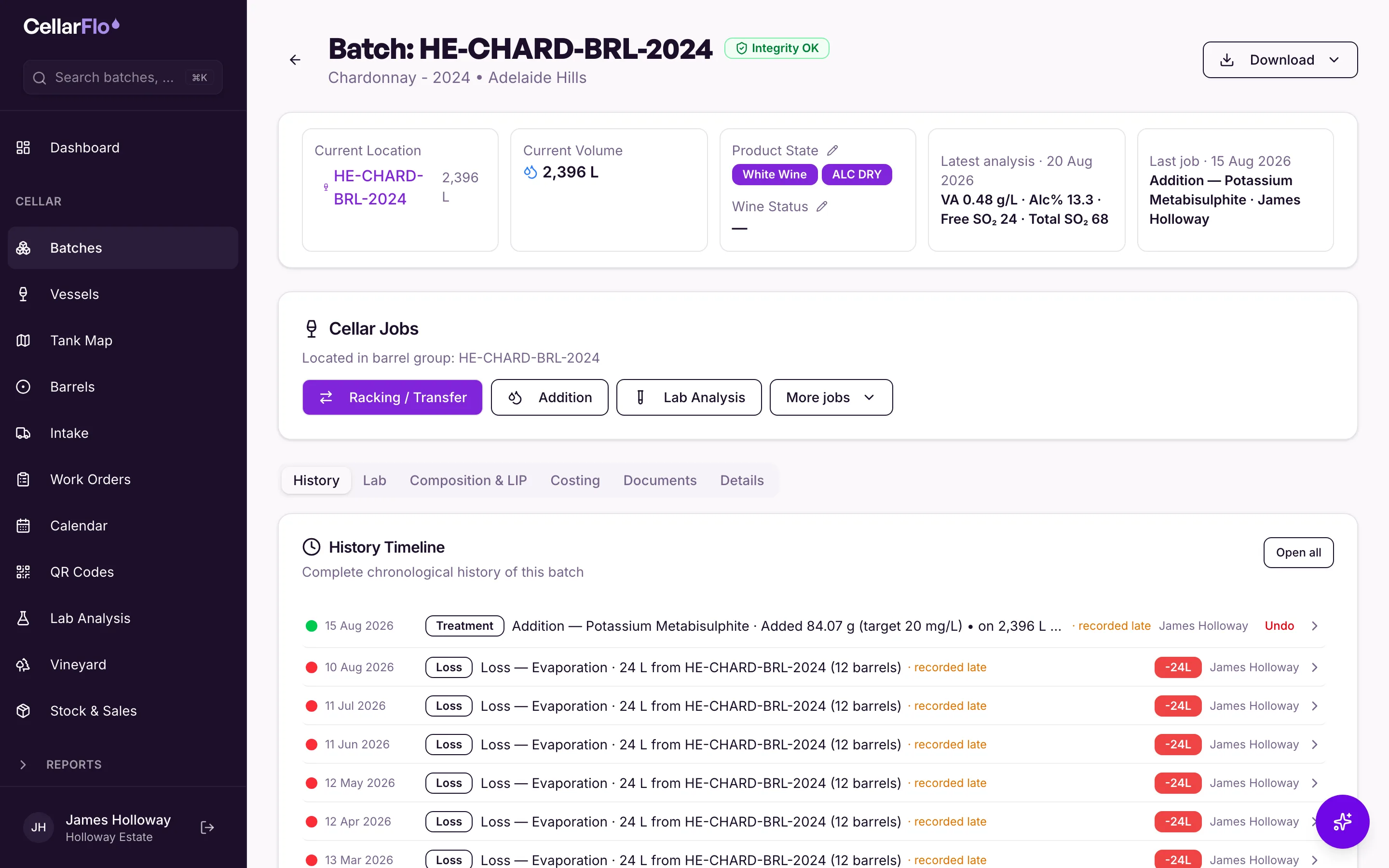
Every job is a dated entry with a name on it.
Each job records when it happened, the vessels, the litres, any loss or gain with its reason, and every batch it touched. It is stamped with the signed-in person who entered it and when they entered it.
Entries are never edited or deleted. A mistake is undone or corrected by a new entry with a reason, and the original stays visible.
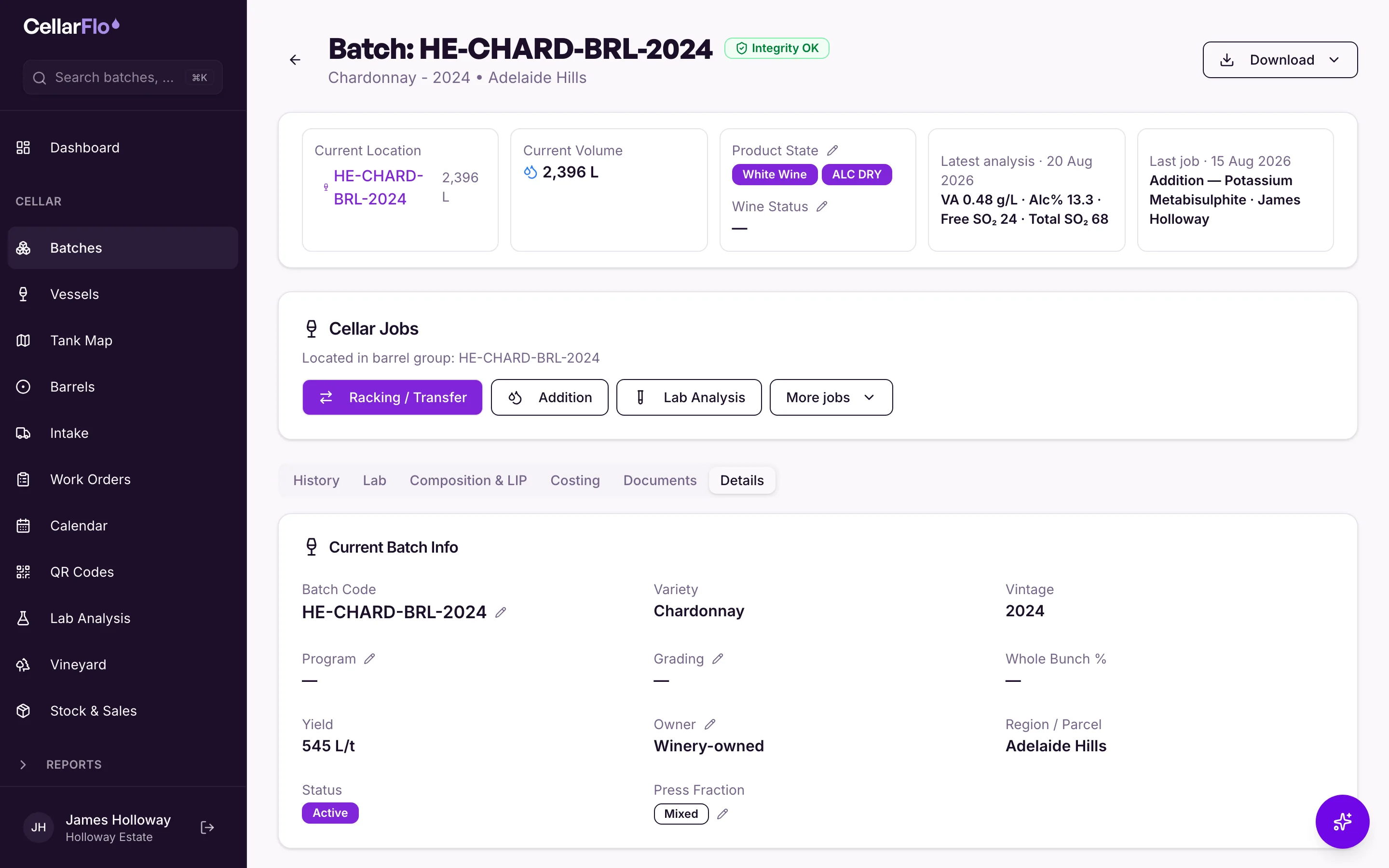
Variety, vintage and region
Calculated from what you recorded, never typed in.
It starts at the fruit docket: grower, vineyard with its address, variety, vintage, region, date received and quantity. A block is optional.
When wine from one batch goes into another, the receiving batch’s make-up is recalculated by volume from each wine’s full make-up, so a blend of blends keeps every underlying percentage. A fact that was never entered shows as “Not recorded”; it is never filled in.
Keeping it honest
Late entries, volumes and the Wine History Report.
Late entries name their original.
A job entered more than 3 days after it happened, counted at your winery’s day, must name the original record it was copied from, such as a cellar book page or a spreadsheet row, or say there is none. Lateness is never hidden.
Litres add up at every step.
Litres out equal litres in plus any recorded loss and any recorded gain, checked when the job is saved. Undoing a job is its exact mirror.
The Wine History Report.
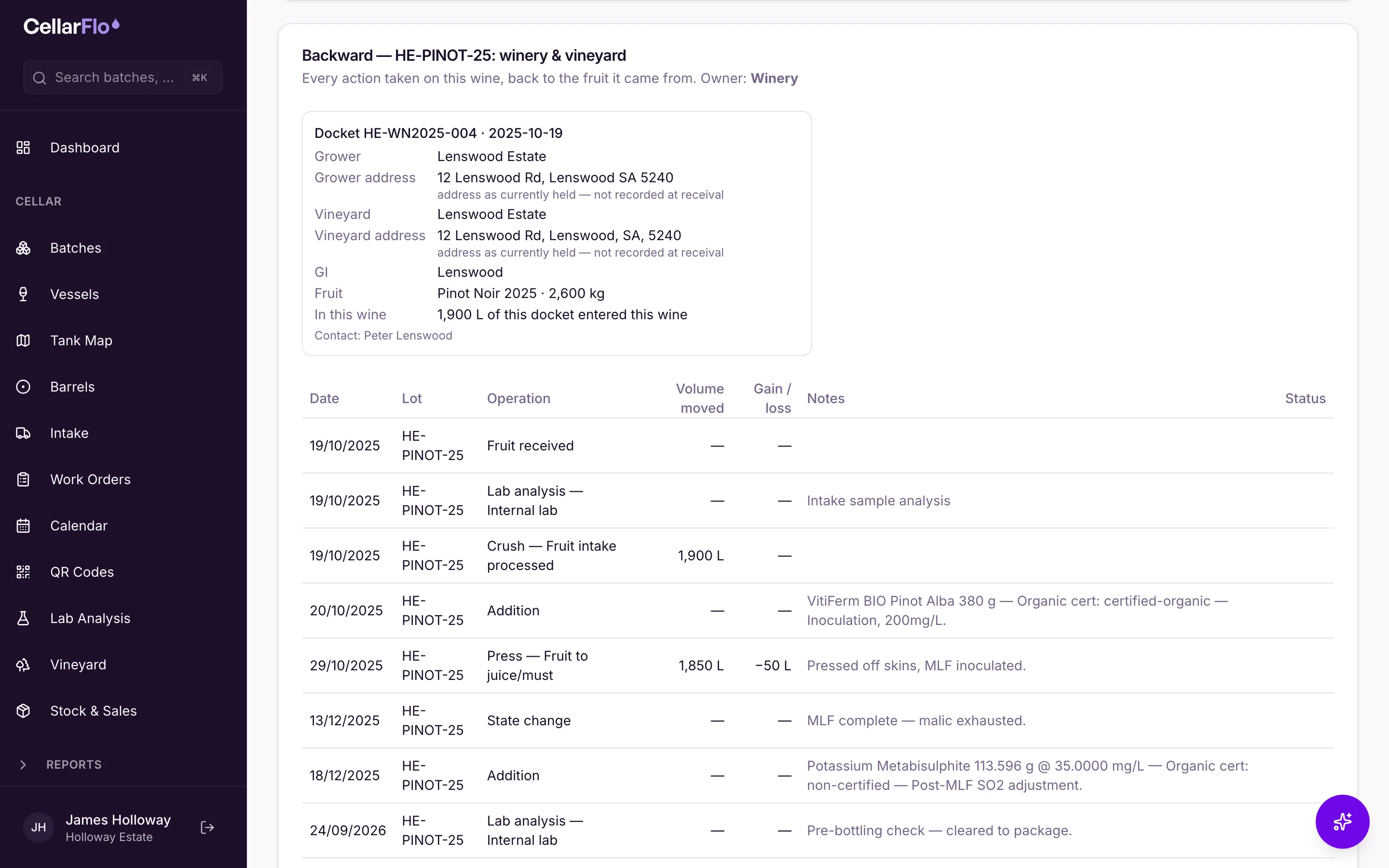
Every action on a wine in one sheet, in true order, with its full origin at the top and a reconciliation to the litre at the end. Additions, movements, packaging and stock-on-hand registers download as CSV, Excel or PDF.
Product recall
From any finished wine back to the vineyard.
Start from a lot code, a SKU, a dispatch docket or a sale order and walk back through every batch, vessel, addition and analysis to the fruit dockets, vineyards and growers.
Or start from a vineyard, grower, docket or batch and follow it forward to every batch, bottled wine, sale and bulk dispatch it reached. On Village, which has no Stock & Sales, the trail starts at the bottling run, and the recall screen says so.
Reports
WET, levies and New Zealand, from the same records.
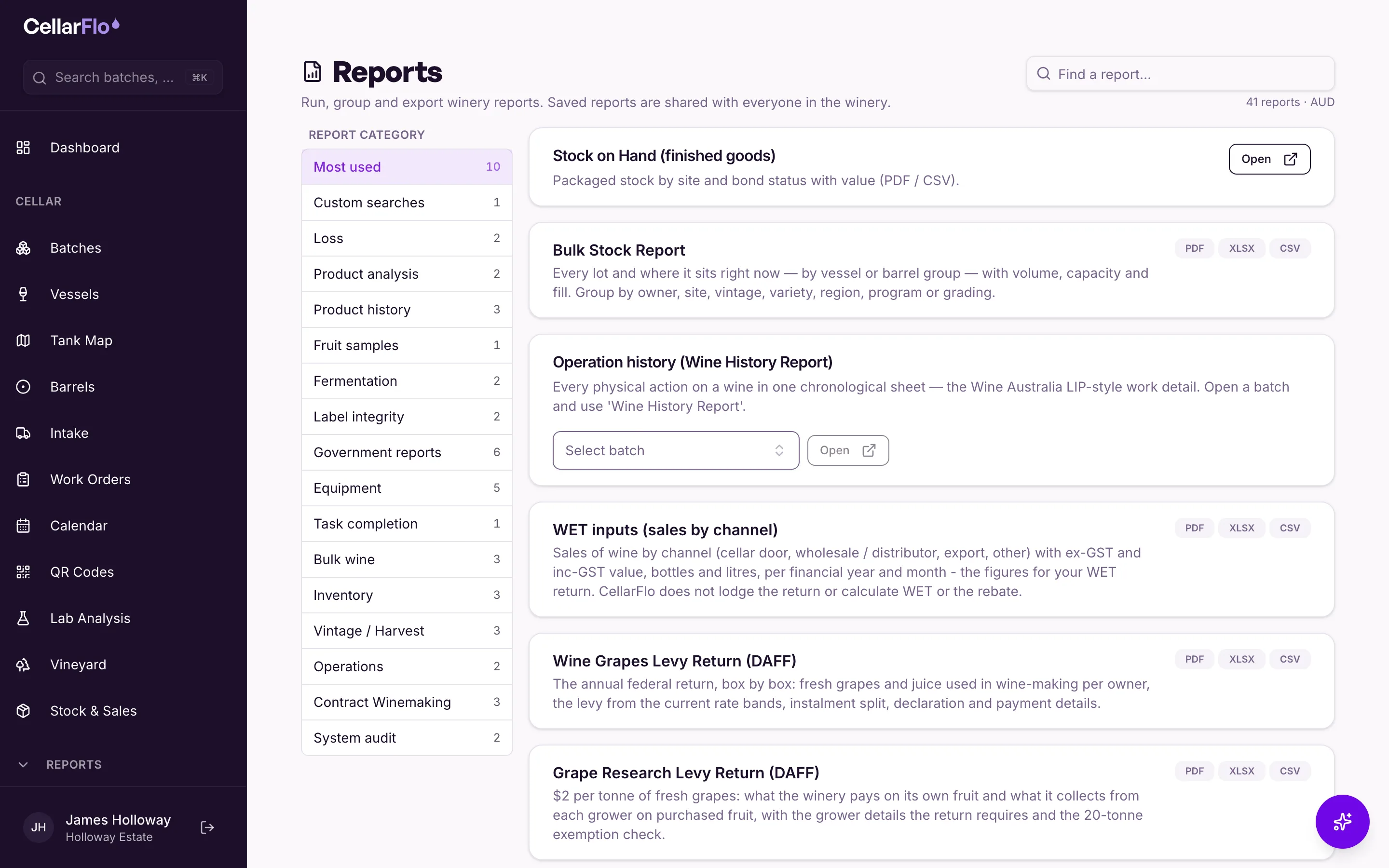
For Australia: WET inputs (sales by channel), the Wine Grapes Levy Return (DAFF), the Grape Research Levy Return (DAFF), PIRSA Wine Industry Fund Contributions (SA), APC Wine Producers’ Fee for Service (WA) and a Regional grower charge statement.
For New Zealand: NZW Winegrape Levy (buyer’s return), NZW Grape Wine Levy (quarterly return) and NZ removals from bond. CellarFlo prepares the figures; it does not lodge a return.
In brief
The basics are on every plan.
- Label Integrity Program records, product recall and backdated entries are on every plan, including Village.
- Every job is a dated entry with the person who entered it, and is never edited or deleted.
- Variety, vintage and region are calculated from recorded fruit dockets and jobs, including through blends.
- A fact that was never entered shows as “Not recorded”.
- WET inputs and NZ removals from bond use sales from Stock & Sales, which is on Estate and above.
Questions
Label Integrity and recall, answered.
Does CellarFlo keep my Label Integrity Program records?
It keeps them as you work: every intake and every job is a dated entry with who entered it and when, and corrections are added as new entries rather than written over. The records are yours to keep and check; CellarFlo does not certify them.
How does it work out a blend’s variety, vintage and region?
By volume, from each component’s full make-up as recorded, back to the fruit dockets. A blend of blends keeps every underlying percentage.
Can I trace a wine back to the vineyard for a product recall?
Yes. From a finished wine you walk back to every batch, addition and analysis, then the dockets, vineyards and growers. From a vineyard or docket you can walk forward to everything the fruit reached.
Can I enter jobs from last week’s cellar book?
Yes, on every plan. An entry more than 3 days late names the original record it was copied from, or says there is none.
Does it do my WET return or levy returns?
It prepares the figures from your records, including WET inputs (sales by channel) and the levy returns listed above. It does not lodge returns or calculate WET or the rebate.
What does it cost?
From $99 a month, with these records on every plan. Wine costing is on every plan too. Build your plan for your exact quote.
See the whole story of a wine.
Open the demo winery, pick a bottled wine and trace it back to the vineyard.