Stock & Sales
Every bottle, from the tank to the customer.
Stock & Sales is a full stock and sales system built into CellarFlo, and every bottle in it stays connected to the wine it was filled from.
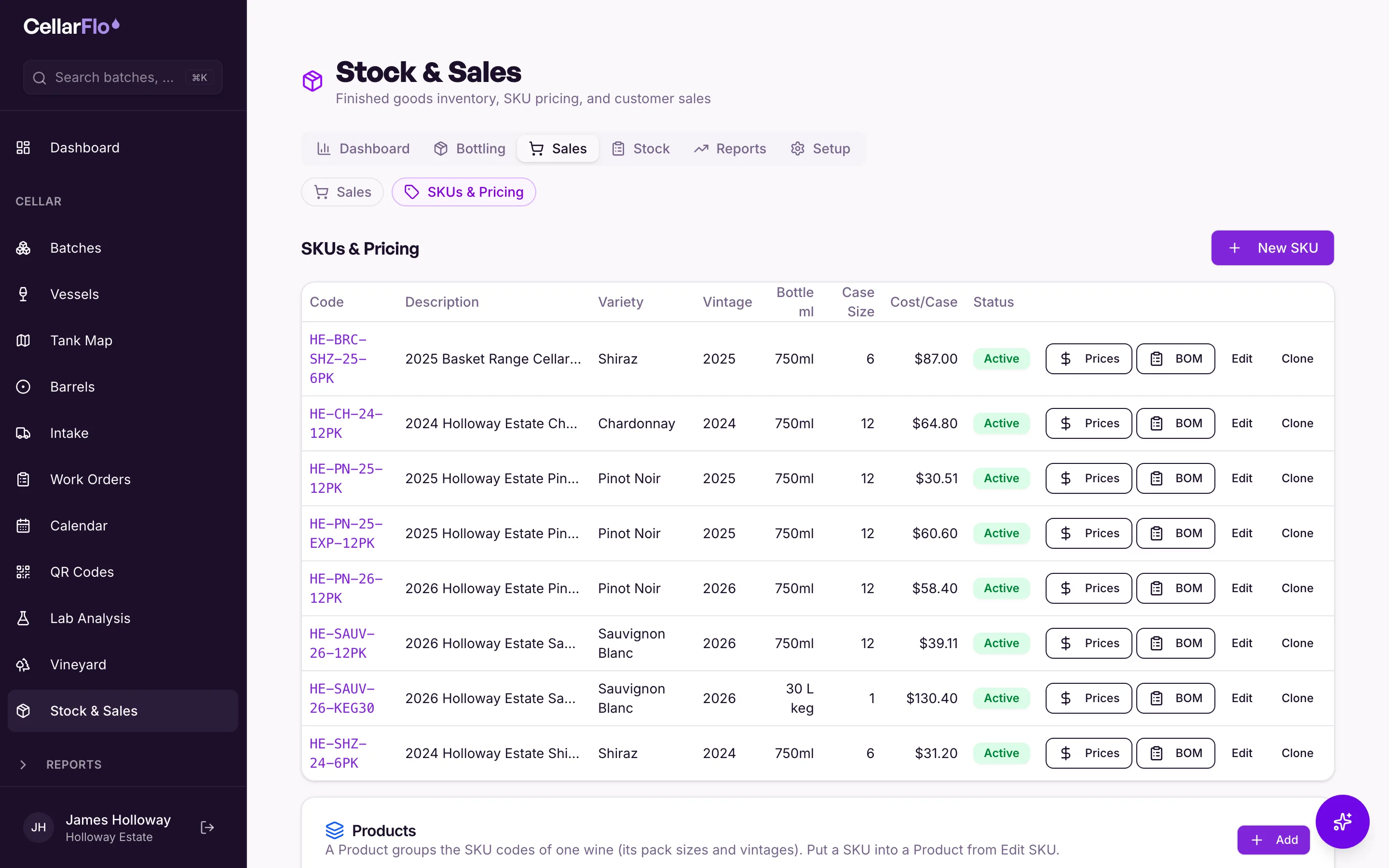
Plan and manage your bottlings.
The Bottling Schedule holds every planned bottling, still, tirage, disgorging, labelling only or kegs, on an exact date, a month or “TBA”, on your own line or at an off-site bottler. Each plan works out the bottles, litres and wine needed, and an estimated cost per pack and gross profit before you bottle.
Create job turns a plan into a Packaging job on a Work Order, with the bulk dispatch drafted too for an off-site bottler. At bottling, the label’s variety, vintage and region are checked against the wine’s recorded make-up.
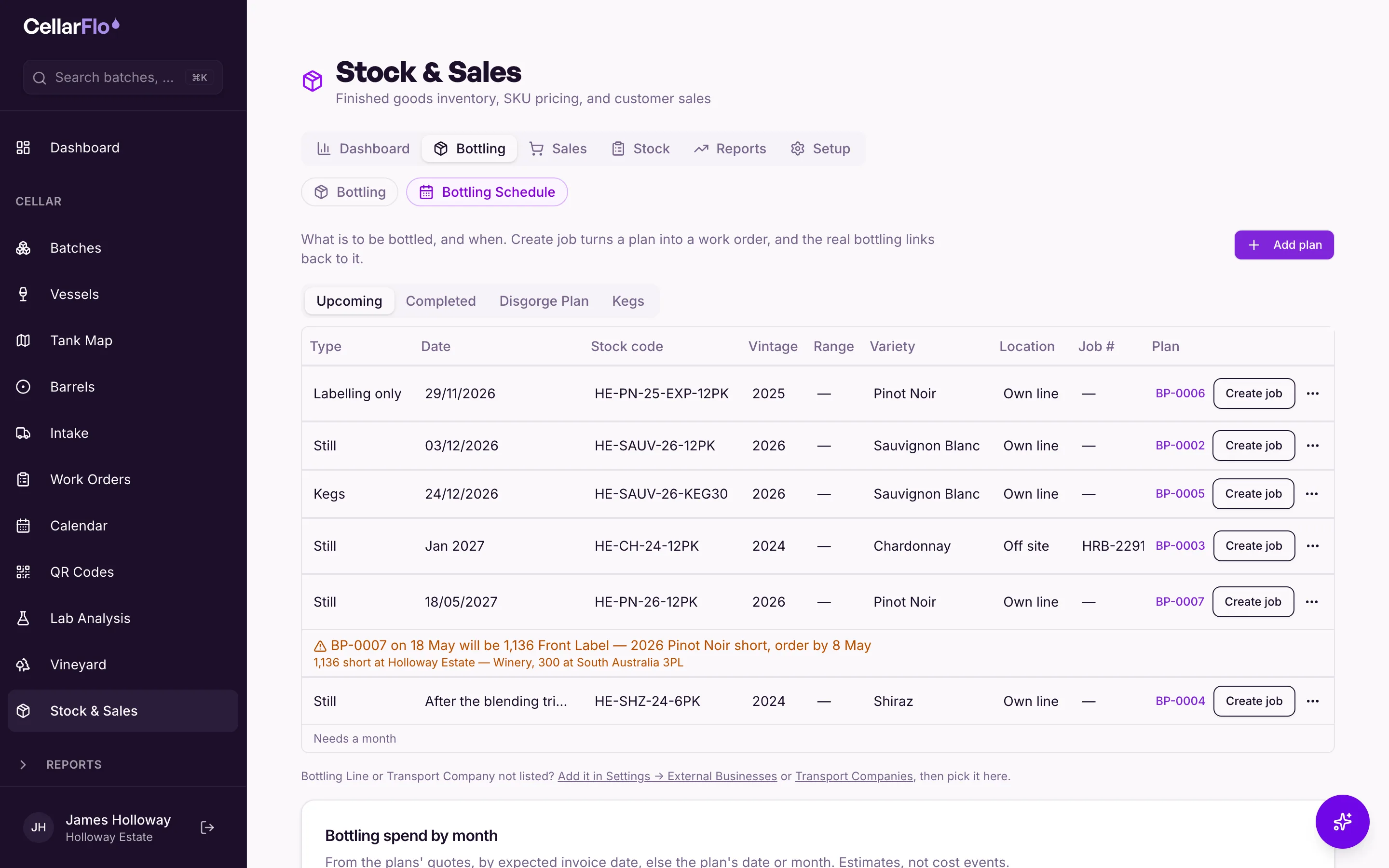
Track your stock and warehousing.
Stock is counted in bottles and shown as cases, loose bottles, pallets and 9-litre dozen equivalents, for each SKU in each warehouse, with what is held for orders and what is in transit. A warehouse can be on site, a third-party store or a bond store.
Transfers between warehouses print their own docket, and a shortfall on arrival is recorded with its reason. Stocktakes reconcile your counts, and the Stock Depletion Forecast rolls stock forward 18 months from your sales and planned bottlings.
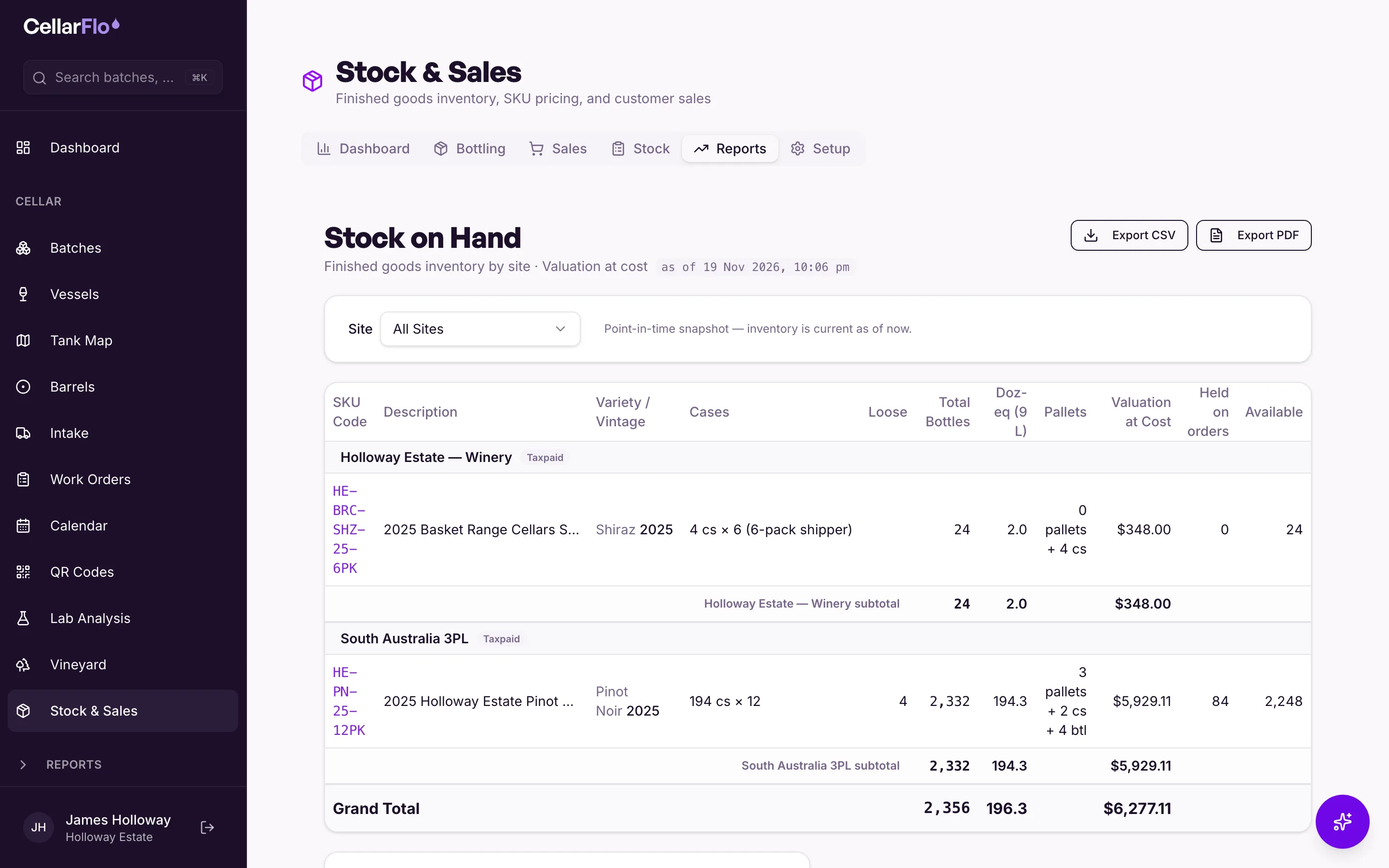
Manage costings, margins and track sales.
Each SKU has a cost sheet for its bottling: the wine at its cost per litre, every dry good, and bottling, transport and pallet costs, per pack and per bottle, beside the previous vintage.
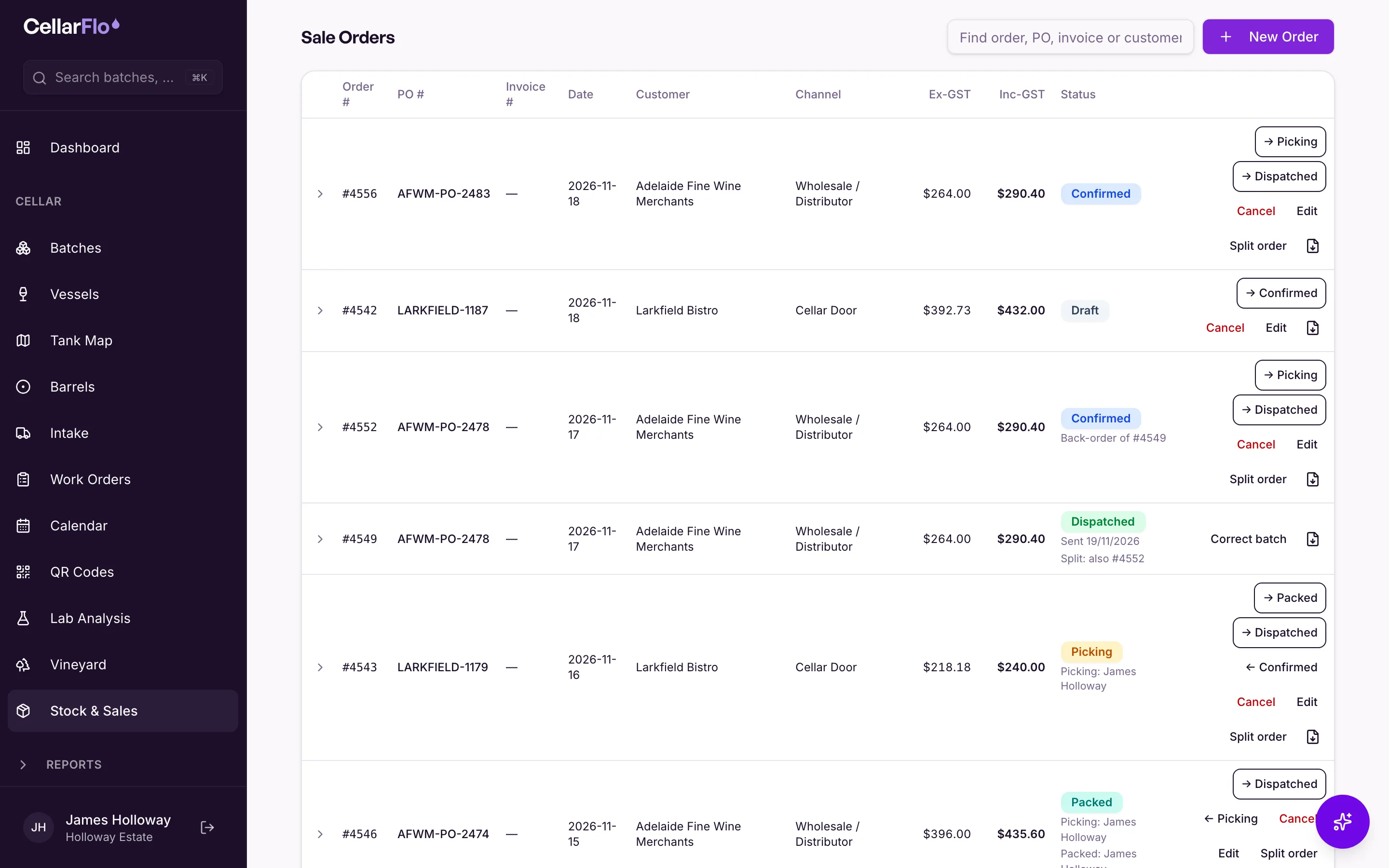
Price lines for each channel show the net price, gross profit and a red, yellow or green light against your target. Sale Orders move from Confirmed to Picking, Packed and Dispatched on the Dispatch board, and sales reports show bottles, revenue and gross profit by channel, customer, SKU and variety, net of returns.
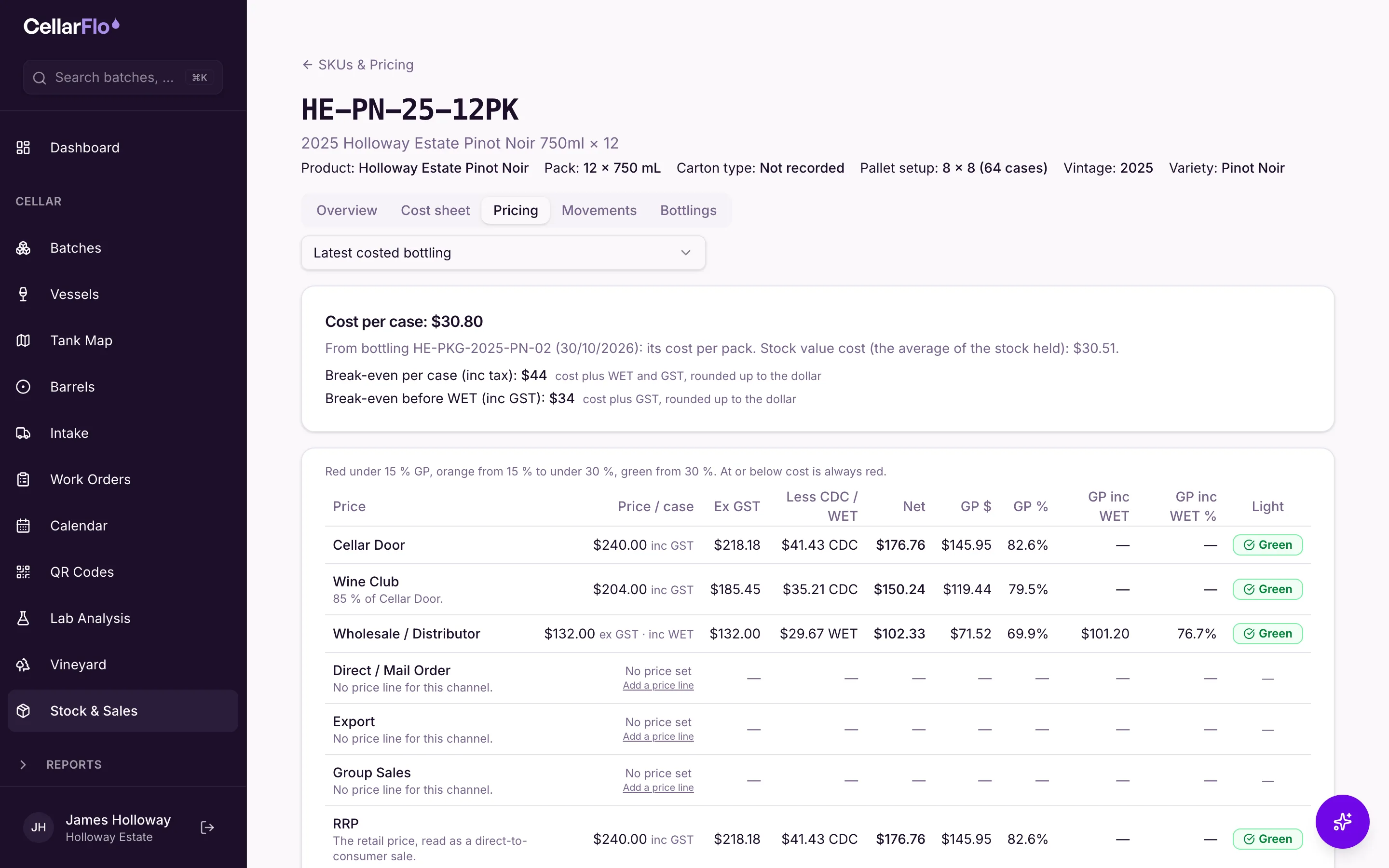
Integrated with your accounting.
Connect Xero, MYOB or QuickBooks. Sales invoices raised there are pulled into CellarFlo, matched to your customers and SKUs, and approved by a person as Confirmed orders ready to dispatch. Credit notes are listed for review and never move stock on their own. Commerce7 orders come in the same way.
With the Contract Winemaking add-on, a client’s month goes back to your accounting software as a draft invoice for you to check and send.


Xero, MYOB and QuickBooks are trademarks of their owners.
Stock traceability and product recall.
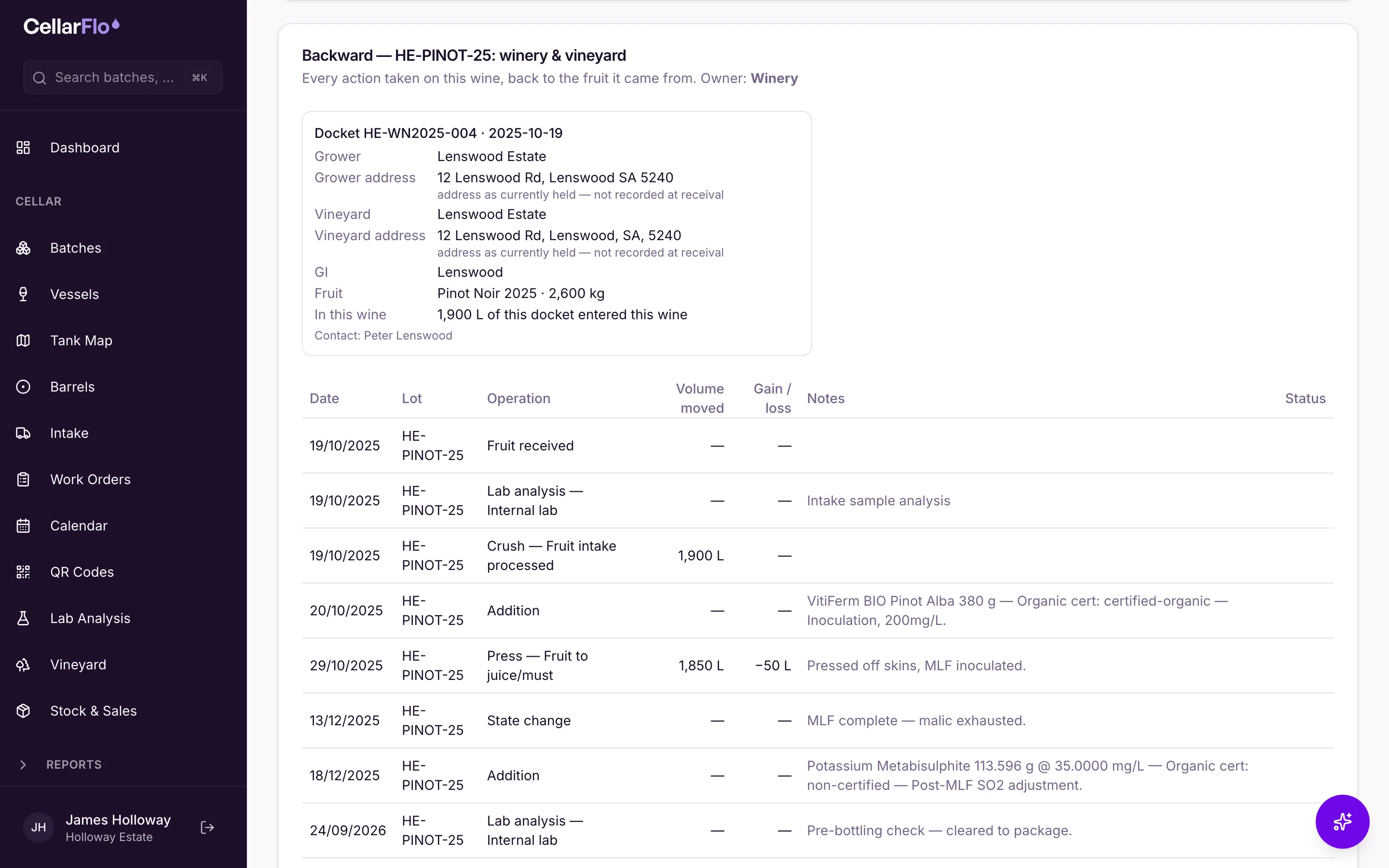
Product Recall starts from a bottled batch code, a SKU, a sale order, a dispatch docket, a fruit docket, a vineyard or a grower. Backwards, it walks from the bottle through every job on the wine to its fruit dockets, vineyards and growers.
Forwards, it shows the bottles still in each warehouse or in transit, and the customers and orders they went to. The trace downloads as Excel or CSV.
Contract bottling management.
Bottles keep the owner of the wine they were filled from, so a client’s bottles sit in stock in the client’s name and can never be sold as yours. A client’s own dry goods are received in their name and used first when you bottle their wine.
Bottling set-up and per case, materials, receiving, dispatching, picking and storage per pallet space are charged at the client’s rate card, and bottles go back by Dispatch to client with a Manifest. Contract bottling needs the Contract Winemaking add-on.
Dry goods management.
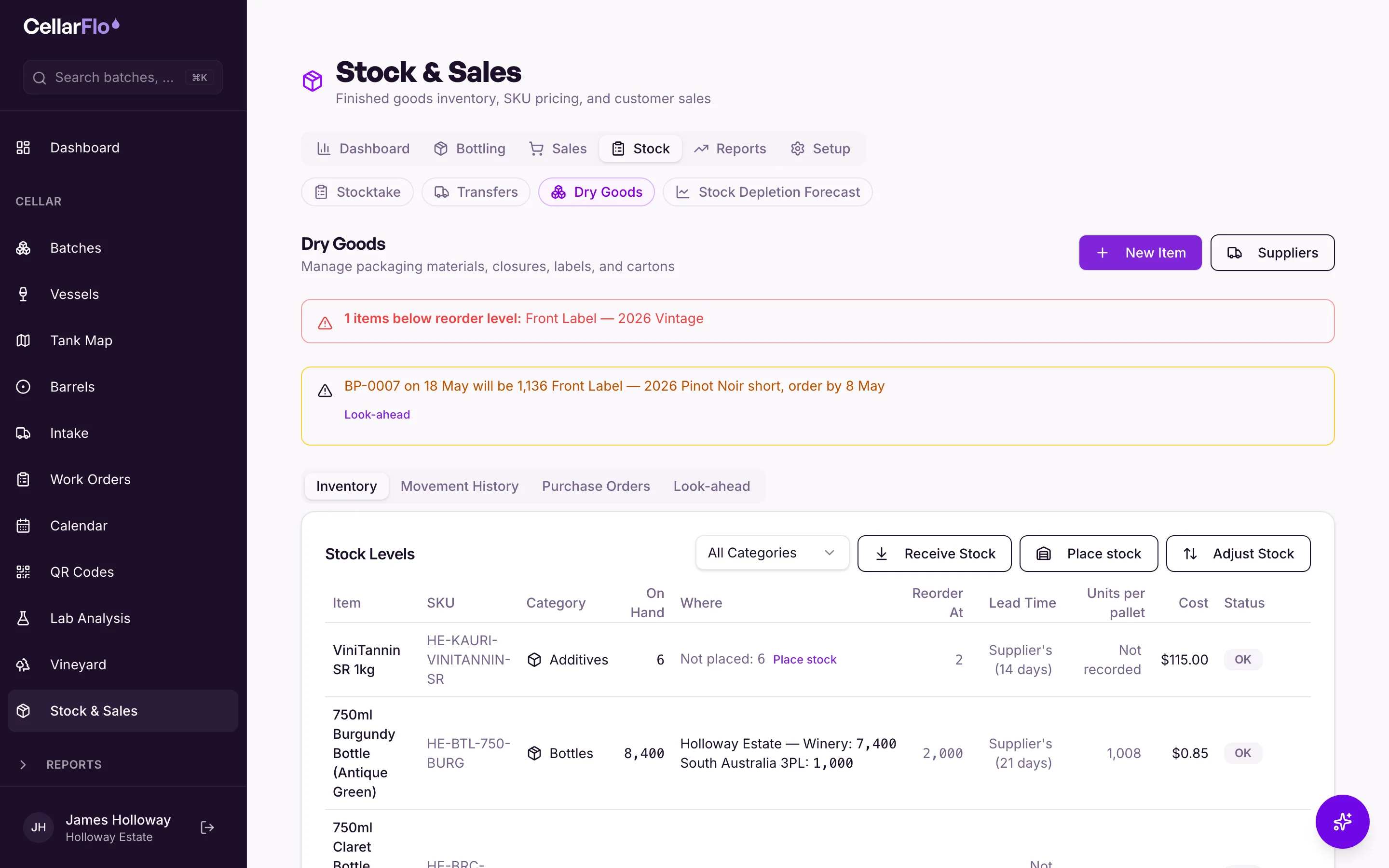
Bottles, closures, labels, cartons and other dry goods are held per warehouse, with suppliers, receipts, reorder levels and a movement history. Each SKU has a bill of materials, so a bottling draws what it used and its cost goes onto the cost sheet.
Purchase orders record what is on its way. The Look-ahead checks every planned bottling against stock and orders, and warns when an item will run short and the date to order it by, counting the supplier’s lead time and artwork approval.
Connected to the cellar
Every bottle knows its wine.
Bottling is a job on the wine, so finished stock never starts on its own: every bottled batch links to its packaging run and the batch it was filled from, with that wine’s cost and records behind it. That link is what lets a recall reach the vineyard from a single sale.
Stock & Sales and accounting connections are on Estate and above. Contract bottling needs the Contract Winemaking add-on. Product Recall is on every plan.
Questions
Stock & Sales, answered.
Which plans include Stock & Sales?
Estate and above. Contract bottling also needs the Contract Winemaking add-on. The plan builder shows what fits your winery.
Product Recall is on every plan. Without Stock & Sales, a recall starts from the bottled batch and its packaging run.
When does stock come off?
When a Sale Order is dispatched, with the name of the person who dispatched it. Until then, a confirmed order holds its bottles, so the available stock shows what is free to sell.
What if the bottling invoice arrives after we bottle?
Add it to that bottling as a cost line when it arrives. The cost moves only for that bottling’s bottles still in stock; bottles already sold keep the cost they sold at.
Do invoices from my accounting software become orders by themselves?
No. Invoices are pulled in and matched to your customers and SKUs, and a person approves each one as a Confirmed order. An invoice changed in your accounting software after that is flagged, never rewritten.
Does it help with WET?
It keeps the records and produces the reports: WET inputs, with sales by channel and period, and own use at cost. What you lodge is for you or your adviser to decide.
Can I sell mixed or gift packs?
Yes. A Mixed pack draws each wine from its own bottled batch when the order is dispatched, so a recall still finds every bottle.
Know your stock. Know your margins.
Open the demo winery and follow a wine from the tank to a dispatched order.