Wine costing
See what goes into every litre.
CellarFlo keeps a dated record of every cost on each batch and shows its cost per litre on the wine you hold today, from fruit intake to bottle.
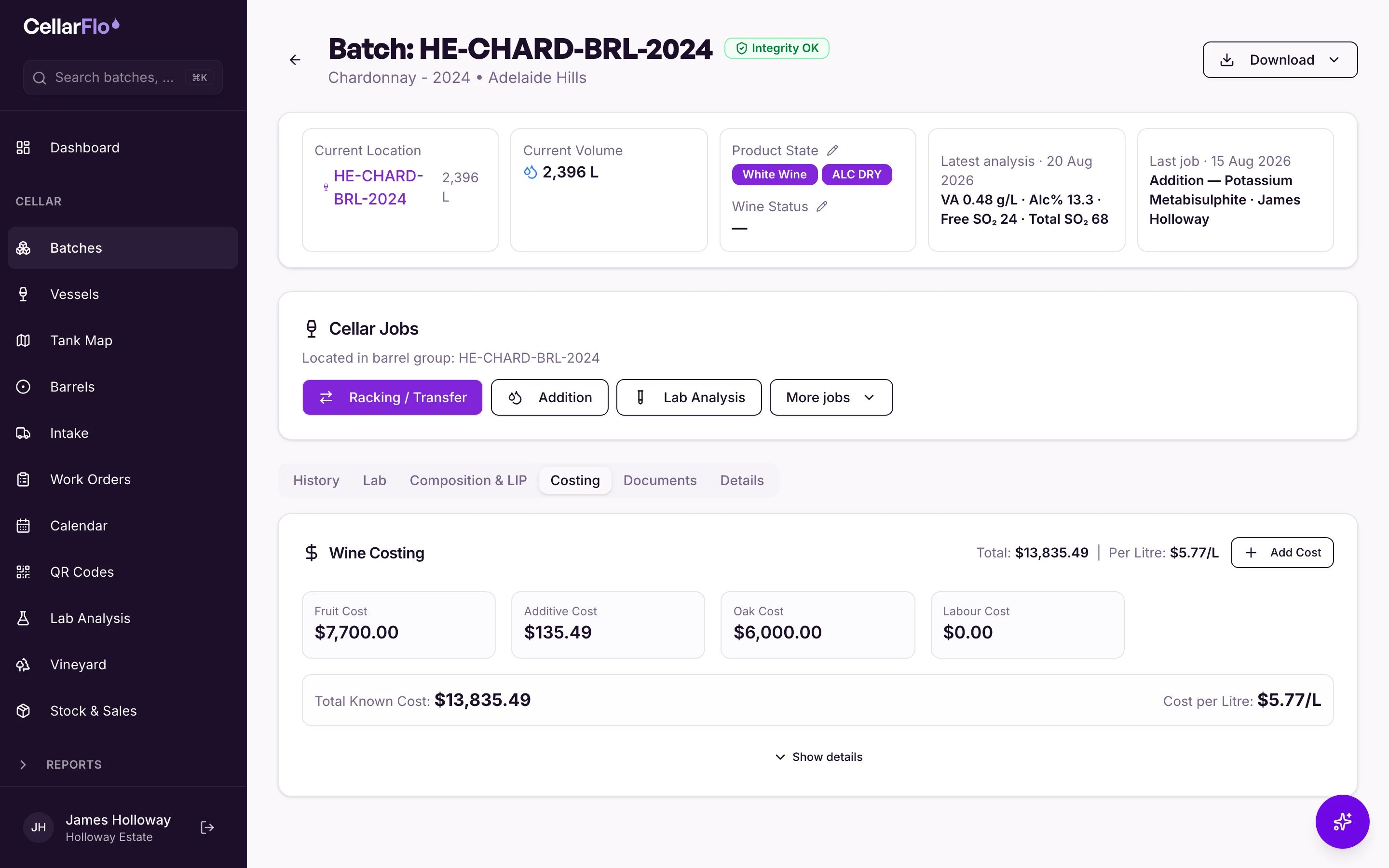
Cost per batch
What goes into a batch’s cost?
Every cost is a dated entry on the batch, with its type: fruit, bought-in bulk wine, additives, labour, oak, filtration, analysis, consulting and other costs.
Most are written by the job itself. Record an addition and its cost is added on that day; fill a barrel and its oak cost follows. The batch’s total is simply the sum of its entries.
Cost per litre
How is cost per litre worked out?
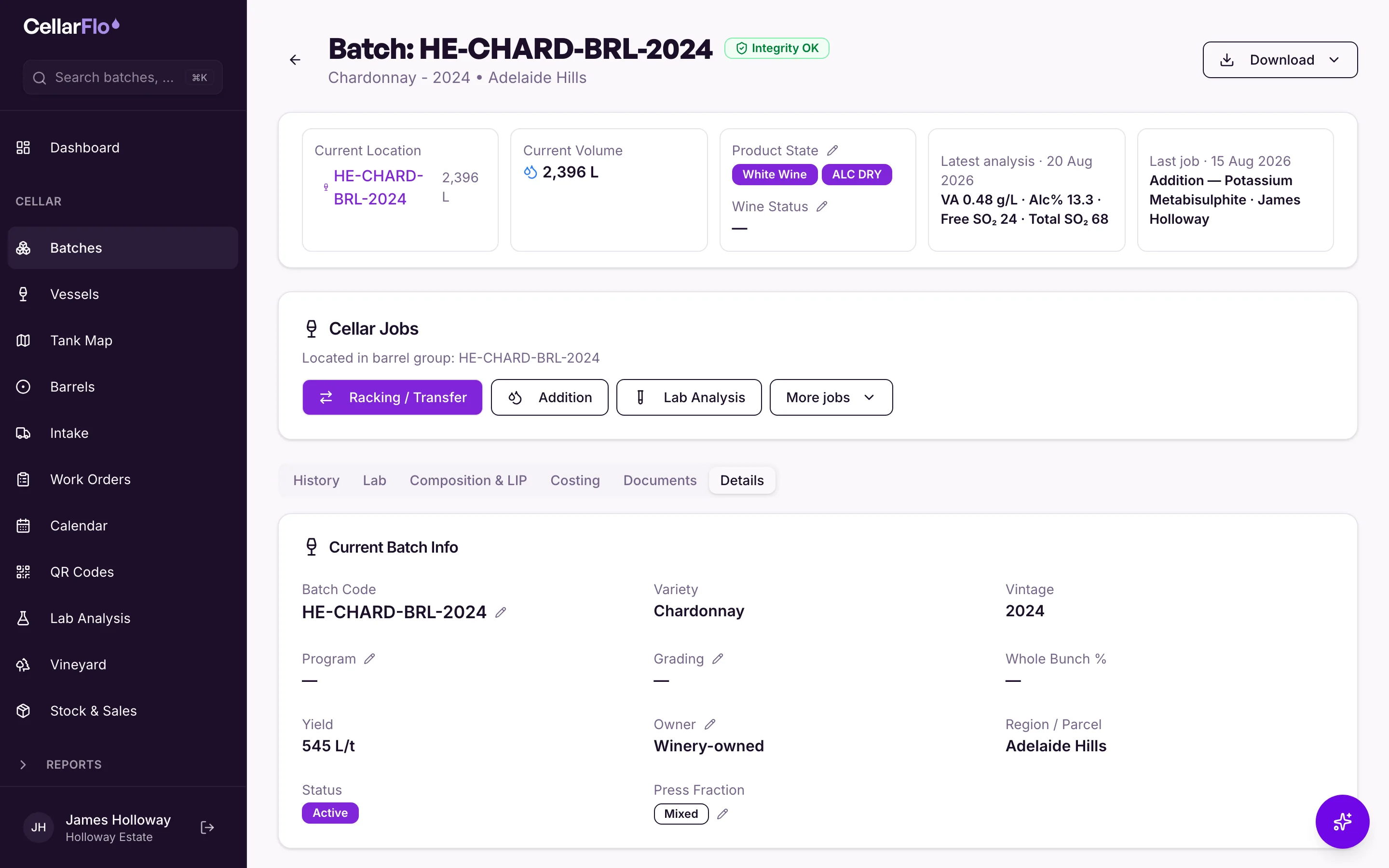
Cost per litre is the batch’s total cost divided by the litres it holds now. It is worked out fresh every time you look, so it moves as the wine does.
Losses to lees, racking and filtration take litres away but leave the dollars, so the same cost is spread over less wine and the cost per litre rises. If a movement arrives with more litres than it left, that gain spreads the same cost over more wine and the cost per litre falls. The total never changes because of a loss or a gain.
An example, with round numbers
- You press 700 L at $3.00 a litre: $2,100 in total.
- Over the year you add $200 of additives. The total is now $2,300.
- You lose 70 L to lees, racking and filtration, leaving 630 L.
- $2,300 across 630 L is about $3.65 a litre.
That is what the finished wine really cost you, not the $3.00 it cost at the press.
Where the costs come from
Fruit, oak and labour, worked out the same way every time.
Fruit from the docket.
The fruit price lives on the intake’s weighbridge docket. When the docket is crushed or pressed, its whole fee is spread evenly over every litre that one job yields, so free run and pressings start at the same cost per litre.
Oak spread over the barrel’s life.
Each barrel has a purchase cost and an expected number of fills. Every fill charges the wine the barrel cost divided by those fills, so the first wine in a new barrel is not loaded with all of it. Racking a wine out and back into the same barrel is the same fill.
Labour at the operator’s rate.
Labour is hours times the hourly rate saved for the person who did the work. If that person has no rate, the hours are kept and the cost shows as “Not recorded”, flagged on the batch.
Blends and bottling
Cost travels with the litres.
When wine leaves a batch, its cost leaves with it at that batch’s cost per litre. What one batch gives up is exactly what the other receives, so no cost is lost or counted twice.
An example of a part blend
- A batch holds 1,000 L costing $3,000: $3.00 a litre.
- You blend 300 L of it into another batch. $900 goes with those litres.
- The first batch keeps 700 L and $2,100: still $3.00 a litre.
A blend is the one moment cost is fixed: each wine’s cost and litres are taken at that instant so the new wine starts with the right dollars. From then on its costs keep building like any other batch.
At bottling, the wine carries its cost per litre into the bottles, and the bottling run shows its cost per case.
Corrections
Nothing is written over.
Cost entries are never edited or deleted. A job that is undone takes its own costs with it, and a cost that was too high is corrected by a new adjustment entry with a reason and the name of the person who made it. The original stays on the record.
Contract winemaking
Billing your clients is an export, not a spreadsheet.
Every cost entry carries its date, its type, the wine’s owner and whether it is billable. A client’s month is a list drawn from those entries, along with charges such as bottling and storage, ready to export as a CSV or send to your accounting software. CellarFlo does not invoice; your accounting software does.
Billing for clients comes with the Contract Winemaking add-on. Sending it as a draft invoice to Xero, MYOB or QuickBooks is on Estate and above.



Xero, MYOB and QuickBooks are trademarks of their owners.
Questions
Wine costing, answered.
Want to see the numbers? Download a sample Excel costing report from the demo winery.
Why does my wine’s cost per litre go up over time?
Because the total only grows as you add things, while losses take litres away. The same dollars spread over fewer litres give a higher cost per litre. That rising figure is the true cost of the finished wine.
How is fruit cost split between free run and pressings?
Evenly. The fee on the weighbridge docket is spread over every litre the crush or press of that docket yields, so every fraction starts at the same cost per litre and the fruit cost across them adds up to the docket’s fee.
How is oak charged?
Per fill. Each fill charges the wine the barrel’s purchase cost divided by its expected number of fills, so the cost is spread across the barrel’s working life.
What happens to cost when I blend part of a batch?
The litres that leave take their share of cost at the batch’s cost per litre. The batch left behind keeps the same cost per litre, with a smaller total.
Can I bill contract clients from it?
Yes, with the Contract Winemaking add-on. Each cost carries the wine’s owner and whether it is billable, so a client’s month can be exported as a CSV or, on Estate and above, sent as a draft invoice to Xero, MYOB or QuickBooks. See contract winemaking.
Is costing on the smallest plan?
Yes. Costing is on every plan, from $99 a month, along with Label Integrity Program records and product recall.
Know your cellar. Know your costs.
Open the demo winery and follow a batch’s cost from the docket to the bottle.